
Brand Suitability
Part of Rewarded advertising campaigns
Avoiding rewards that create misleading ad interactions
A reward should encourage a voluntary ad experience, not make a player click, install or purchase under a false impression.
A reward should encourage a voluntary ad experience, not make a player click, install or purchase under a false impression. Brand and publisher both benefit when the required action and the promised benefit are clear before the ad begins.
The ACCC says a business must be able to prove any claim it advertises, and claims should be true, accurate and based on reasonable grounds. The Australian Consumer Law protects consumers from certain unfair behaviour by businesses. The ACCC accepts reports about possible misleading claims and may investigate and take compliance or enforcement action.
Inspect the prompt and the payoff
Check the wording a player sees: it should state the required action and the reward that follows. Confirm the network's current rules for the specific format.
Google AdMob's help page is titled “Policies for ad units that offer rewards”; check its current requirements for the format you use. Google’s AdMob Unity guide describes rewarded ads as ads users may choose to interact with in exchange for in-app rewards.
If watching is enough, “Click the ad to claim your reward” misstates the condition. “Watch this ad to earn the in-game reward” makes the viewing condition clear.
Avoid prompts that imply the player must click through to the advertiser when merely viewing or interacting with the ad satisfies the reward condition. Keep advertiser buttons distinct from game controls, and do not disguise a button as part of the game.
If the ad is skippable, describe what happens to the reward accurately. Test a player skip and an ad load failure; Google AdMob's Unity guide identifies a load error as an ad that failed to load. State the reward outcome for each path before the player opts in, and ensure a completed action does not leave the player empty-handed.
Key checks for ethical reward-based ads in Australia
- Use clear, accurate language: e.g., 'Watch this ad to earn the in-game reward'Yes
- Avoid misleading prompts like 'Click the ad to claim your reward' if watching is sufficientYes
- Ensure advertiser buttons are distinct from game controls and not disguised as gameplay elementsYes
- Clearly state reward outcomes for both successful ad views and skips/failuresYes
- Do not imply a click-through is required when viewing alone qualifies for the rewardYes
Separate reward response from brand response
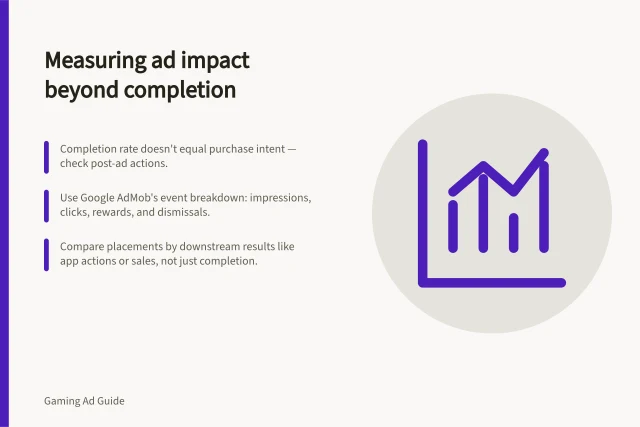
Report reward-earned events, ad clicks and post-click actions separately. A sudden rise in clicks without useful landing behaviour may indicate confusing creative or accidental interaction, not brand success. Inspect a sample of the actual flow and fix the wording or controls before optimising towards those clicks.
Keep the advertiser's call to action optional and truthful. The player should receive the stated in-game benefit under the disclosed rules, while the brand earns attention by being relevant rather than by exploiting the reward mechanic.
Pros and cons of using rewarded ads with transparent mechanics
- ProsBuilds trust with Australian users; reduces risk of ACCC enforcement action; improves long-term user retention
- ConsMay reduce short-term click volume if creative is too honest or lacks urgency; requires careful testing and compliance monitoring