Audience Planning
Part of Gaming advertising experiments
Comparing genres with a consistent message
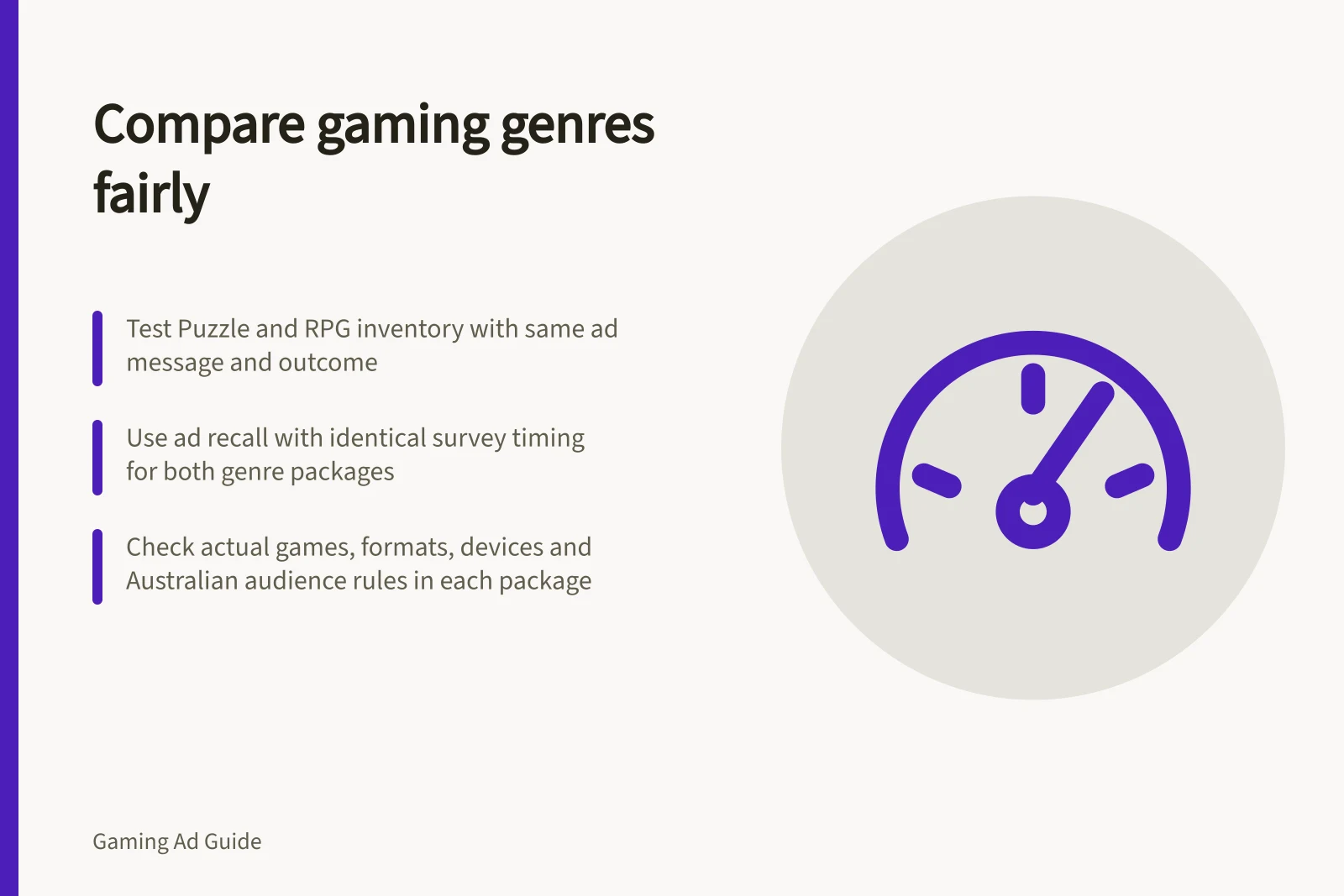
Compare gaming genres using a consistent message, defined inventory packages and one agreed outcome.
Test one ad message across two named inventory packages: Puzzle and RPG. The gaming groupings place Puzzle under Casual and RPG under Midcore; label the packages by those genres and compare them using the same outcome, such as ad recall. The result can guide a choice between the tested packages, but cannot establish that genre alone caused a difference if players or placements also differ.
Define the two packages
Choose Puzzle-game and RPG-game inventory with suitable Australian availability during the same period. List the games, devices, formats and points in play included in each package. A genre label does not describe the ad opportunity, so check what each package actually includes.
If one package offers rewarded video and the other only a game-world sign, the comparison includes those format differences. Treat Puzzle and RPG as the package labels, not as a guarantee that the ad opportunities match.
Prepare one message brief with the same brand, claim, essential qualification and intended next action. Adapt dimensions when required, then check the rendered versions. Record differences in length, sound, clickability or timing that could affect the outcome.
Comparison of Puzzle and RPG Game Inventory Packages
- Genre
- Puzzle (Casual)
- Genre
- RPG (Midcore)
- Available in Australia
- Yes
- Supported Devices
- Mobile, Web
- Ad Formats
- Rewarded video (Puzzle), Game-world sign (RPG)
- Placement Types
- In-game interstitials, banner ads
Use one outcome definition
Set ad recall as the primary outcome before launch. Use the same survey question and timing for both packages, then compare the Puzzle and RPG results side by side. Without an outcome result for each package, there is no observed winner.
If you choose an action comparison instead, use the same destination event and observation window for both packages. Click rate is unsuitable when one surface cannot be clicked.
Ask for counted impressions and distinct reach by named game and genre where the seller can supply them. State whether reach counts people, accounts or devices, and check measurable exposure and unknown delivery. More impressions in one genre may mean more opportunities or repeated contact, rather than a stronger response to the message.
Key Metrics for Ad Recall Outcome
- Primary Outcome
- Ad recall
- Counted Impressions
- Yes, by game and genre
- Reach Metric
- Distinct devices
- Measurable Exposure
- Confirmed via IAB standards
Compare eligible groups
If the buying path permits, assign eligible units to the two genre policies before delivery. Check whether those units can encounter both sets of games and report actual delivery separately from assignment. If assignment is infeasible, align targeting and dates as closely as practical and describe the result as observational. People who choose different games may already differ in ways the report cannot show.
Before choosing a winner, inspect the delivered game and placement mix, creative versions, group sizes and uncertainty where available. A conclusion should name the tested games, message, formats, Australian audience rule, period and outcome. Use it to choose a limited next allocation or another test; do not extend it to every game in either genre.
Pre-Launch Requirements for Valid Comparison
- Assign eligible units to both genre policies before deliveryRequired if feasible
- Ensure same message brief across packagesOne brand, claim, qualification, action
- Check rendered versions for consistencyDimensions, sound, clickability, timing
- Confirm alignment of targeting and datesAs close as practical
- Report actual delivery separately from assignmentWhere possible