In-Game Formats
Gaming advertising experiments
Plan a gaming ad experiment around one decision, comparable groups, measurable outcomes and clear limits on the result.
A useful gaming advertising experiment tests a decision the next buy depends on. Define one question, the outcome and the comparison before launch. Decide in advance what evidence would justify expanding, revising or stopping the buy.
Choose the decision
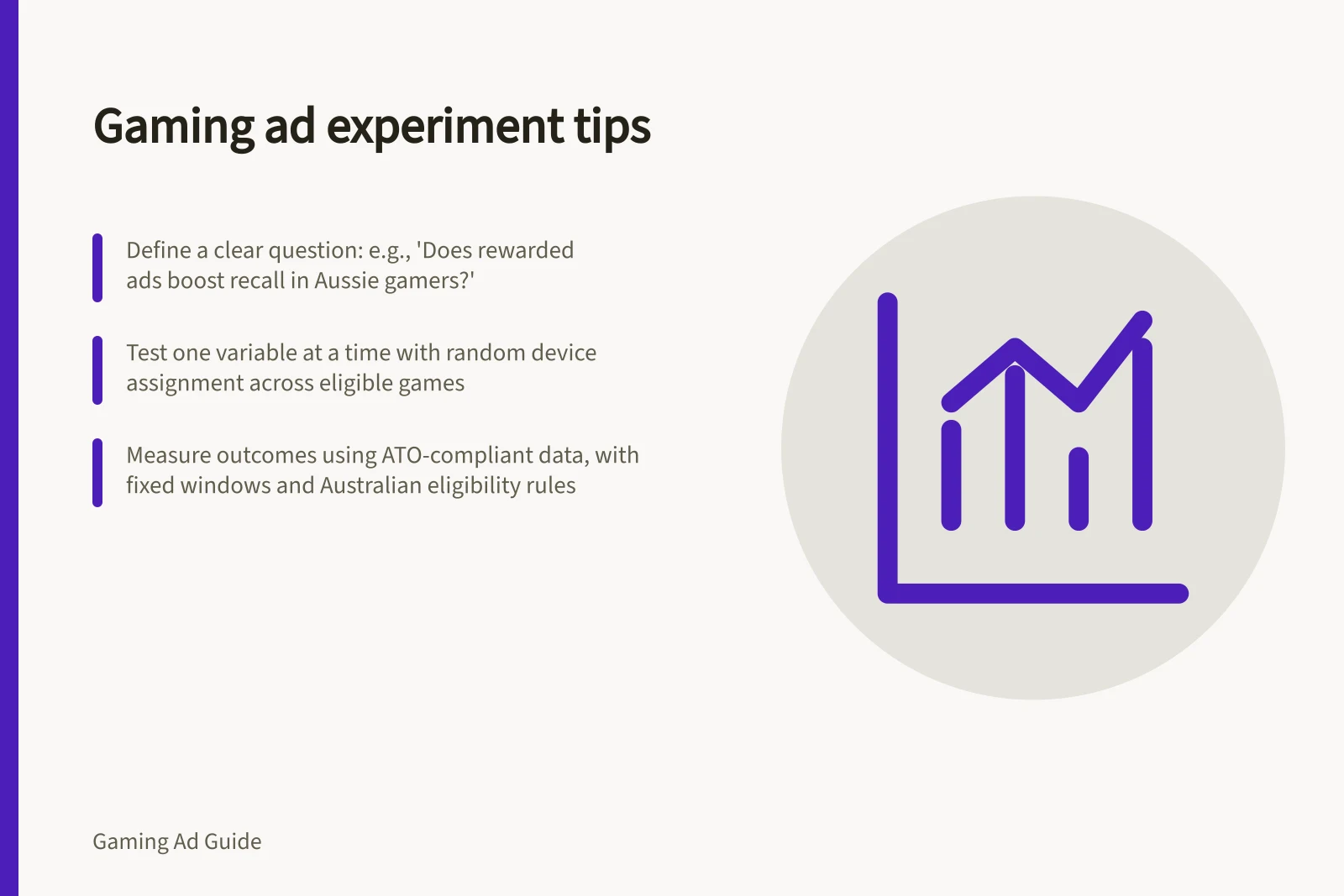
A question such as “does gaming work?” is too broad. Specify the Australian audience, eligible games and devices, campaign period, message and primary outcome. Then identify what changes between groups.
| Decision | Planned difference | Main limit to check |
|---|---|---|
| Compare genres | Which named games can carry the same message and placement? | Players and ad opportunities may differ between games. |
| Compare rewarded and non-rewarded ads | Does the complete player experience change the later outcome? | Reward completion is not brand response. |
| Test repetition | Does a higher assigned exposure policy improve recall? | Recorded frequency may differ from assigned frequency. |
Keep other important conditions as consistent as practical. If format or audience must change with the tested option, treat the result as a comparison of those complete packages.
Build a comparison the buying path can support
Ask the seller what can be assigned to a group: a person, account, device or another defined unit. Where feasible, randomly assign eligible units before delivery and keep the allocation, exclusions and outcome window fixed. Check whether a player can cross groups through another device, game or campaign.
Assignment and delivery are different. A unit assigned to a rewarded offer may decline it; another may never encounter an ad opportunity. Report outcomes for the assigned groups as well as actual delivery. Selecting only people who completed an ad can make the groups incomparable after assignment.
If random assignment is unavailable, describe the comparison as observational. Differences may reflect the players, opportunities and timing as well as the advertising.
Agree on measurement before launch
Define counted impressions, distinct reach, the reach unit, Australian eligibility and the denominator of each rate. Ask which exposure and outcome fields the proposed games, formats and devices can actually report.
For a recall question, arrange the survey wording, eligible respondents and timing before buying. For an action question, define the useful event and give groups the same outcome window.
Make the bounded decision
Check assignment, delivered inventory, measurable exposure and missing data before interpreting the primary outcome. Show group sizes and uncertainty where available. A platform-attributed action is different from an incremental action supported by a suitable experiment.
State what the result covers: the tested games, placements, audience rule, period and outcome. A genre comparison does not rank every game in either genre; a rewarded comparison includes the incentive and player choice; a frequency comparison concerns the policies actually tested. Record deviations beside the decision so the next test can address them.
Interpret results in context
In Australia, the Australian Competition and Consumer Commission (ACCC) administers and enforces the Competition and Consumer Act 2010 and other legislation. It promotes competition, fair trading and consumer protection across Australia.
In this guide
- Comparing genres with a consistent messageCompare gaming genres using a consistent message, defined inventory packages and one agreed outcome.
- Testing rewarded and non-rewarded placementsDesign a rewarded versus non-rewarded game ad test around the player experience and a shared campaign outcome.
- Measuring whether exposure frequency improves recallTest whether repeated game ad exposure improves recall with assigned frequency policies, consistent surveys and clear coverage limits.
- Recording a campaign result when measurement coverage is limitedDocument a gaming experiment result with its measured population, unknown delivery and limits on the decision it supports.