Audience Planning
Part of Gaming audience planning
Distinguishing a game's player base from its ad audience
Learn why a game’s players, eligible ad audience, ad opportunities, impressions and reach are different figures in a media plan.
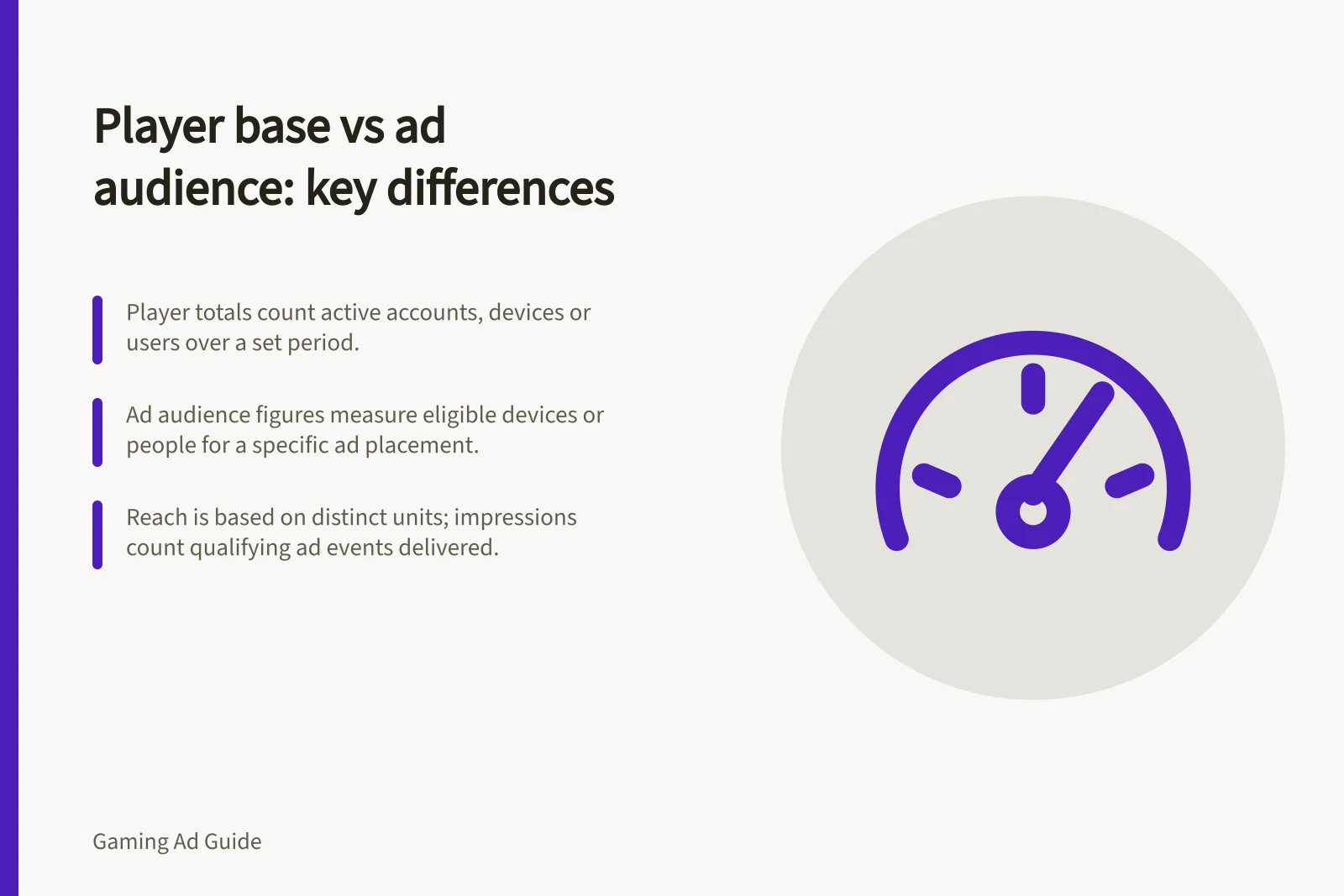
A player-base figure counts people, accounts or devices in a stated measure of play. An ad-audience figure counts those eligible for, or reached by, a particular placement in a stated period. Check both definitions before using a game's player total to support a media buy.
Follow the narrowing path
Ask what the player total counts, and for which dates and market. Then identify which players could receive the proposed ad. Some may use a device or game version without the placement, fall outside targeting rules, or never reach the relevant point in play.
Separate players, eligible audience, ad opportunities, counted impressions and delivered reach. Eligible people or devices are not the same as the opportunities they generate: one eligible unit can create several opportunities. Impressions count qualifying ad events; reach counts distinct units under a stated method and period.
Where a proposed buy relies on the IAB, IAB Tech Lab and Media Rating Council's Intrinsic In-Game Advertising Measurement Guidelines 2.0, ask the seller which counting rules apply to the formats in that buy. Treat any claim that a request, session or another event qualifies as an impression as something to verify against the applicable framework.
Check the reach unit
The Interactive Advertising Bureau publishes a Gaming Measurement Framework. Ask a seller whether a unique reach figure refers to people, households, devices or accounts, and how accounts relate to people. A seller might also report accounts; ask whether one person can hold multiple accounts.
One person may use several devices; several people may share one console or local game session. Ask what identity signals support deduplication. If the method measures devices, label the result as device reach, not unduplicated people.
Key Metrics in In-Game Advertising Measurement
- Player Base
- Total active players (device/account-based)
- Eligible Audience
- Players within targeting parameters (e.g., region, device)
- Device Reach
- Unique devices reached (not people)
- Delivered Impressions
- Viewable ad events that occurred
- Unduplicated Reach
- Distinct individuals or devices reached over time
Compare figures on matching terms
An annual player total beside a monthly campaign reach forecast is not a conversion rate. The figures may differ in period, geography, eligible inventory and counting unit. Request a short explanation of each step from the player estimate to the ad forecast, marking unknown stages as unknown.
- What qualifies a person, account or device for the player total?
- Which games, devices and placements are in the ad forecast?
- Does the forecast use past delivery, modelled availability or another method?
- What unit, period and Australian location rule does it use?
- What distinct reach can be reported after delivery, and where is measurement unavailable?
Use player research to decide whether a title merits consideration, eligible-audience estimates to judge possible scale, and delivered impressions and reach to assess what ran. Even a counted or viewable impression does not prove attention or a later customer action.