Attribution
Part of Intrinsic in-game advertising
Measuring exposure without treating every game session as an ad view
Separate game sessions, ad requests, rendered impressions and viewable exposure in intrinsic in-game campaign reports.
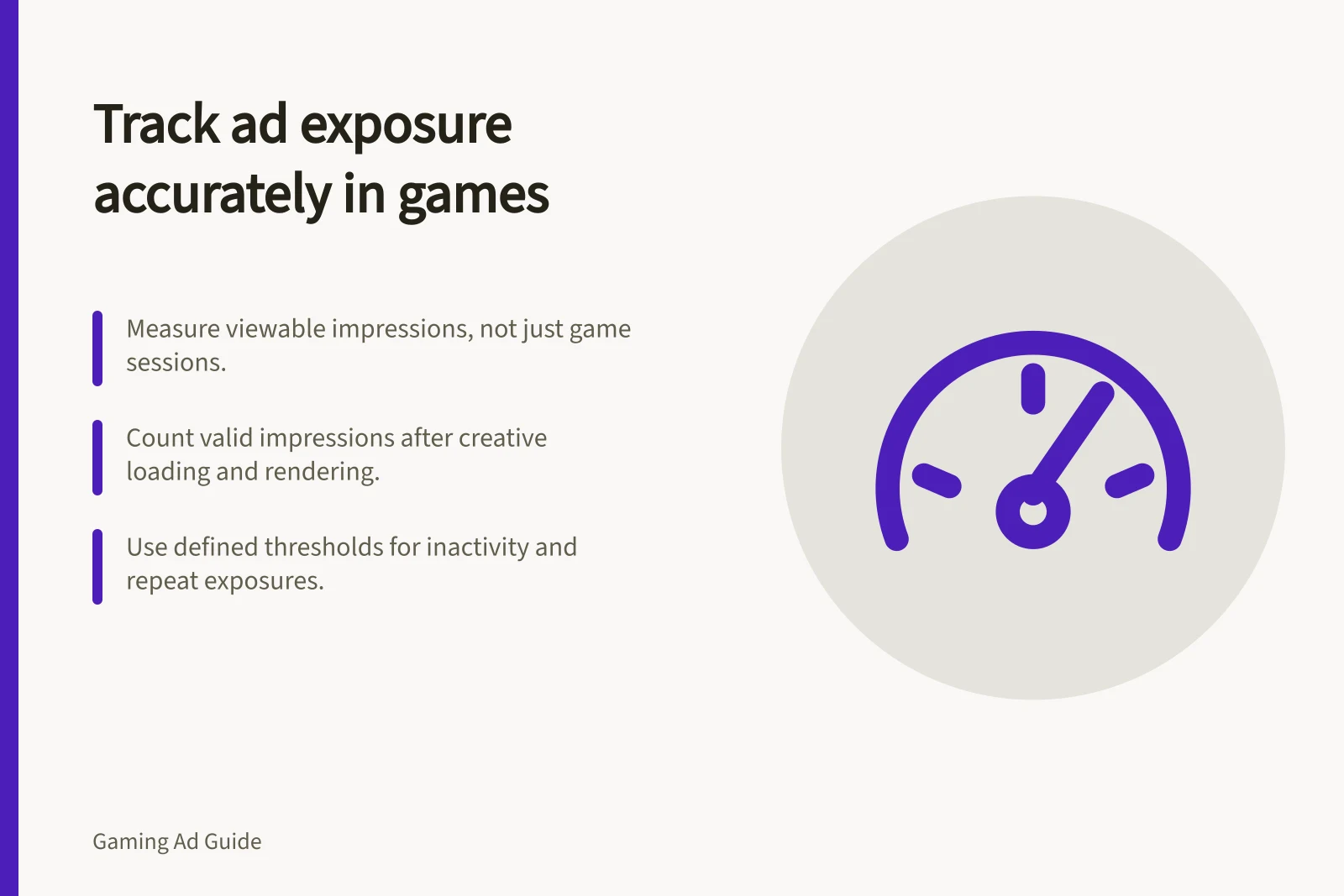
Measure intrinsic ad exposure from defined ad events, not game starts. A session may end before a player reaches a billboard, continue while the player is idle or show a surface without the booked creative. Distinguish sessions, ad requests, valid impressions and impressions that qualified as viewable.
Build an event ladder
Ask which stages the seller can observe. Eligible sessions provide context. An ad request shows that a placement asked for a creative; it does not establish delivery.
Ask the seller to document what event qualifies as a valid impression and how invalid traffic is handled. A valid impression is distinct from an ad request; the seller should explain what delivery evidence its count represents.
A viewable impression adds visibility conditions, which the seller should document. Ask for viewable, non-viewable and undetermined impression counts, plus the measured rate. A single figure labelled “views” obscures those differences.
| Stage | What it establishes |
|---|---|
| Game session | Play occurred; ad delivery is not established |
| Ad request | A creative was requested; rendering is not established |
| Valid impression | The creative loaded and began to render under the counting method |
| Viewable impression | A measured opportunity to see under stated criteria |
| Brand or business outcome | A separate result needing its own measurement design |
Check repeats and inactivity
A player may pass a surface more than once, and a rotating surface may display different creatives. Ask how the seller identifies each ad unit, creative and refresh.
Ask how repeated exposures are counted, including whether the same ad can be counted more than once as viewable when a player moves away and returns. If replays or a cool-off period affect reporting, ask how those are defined and applied.
Ask how inactivity is defined and handled, and what idle threshold the seller uses. A waiting room may still contain an active player, so the appropriate threshold can depend on the game. A device session is not automatically one person, particularly where people share a console or play locally together.
In-Game Advertising Measurement Standards (Australia)
- Replay count policy
- Counted only once per unique player per session
- Invalid traffic filter
- Must be applied pre-reporting per MRC guidelines
Reconcile the report
Use a consistent reporting period and time zone. Request available breakdowns by game, placement, device and creative, and ask how offline records are received later.
Check whether invalid traffic was filtered and whether estimates are separated from directly identified counts. If rendered and viewable totals differ sharply, investigate the surface, camera path and measurement coverage before interpreting the gap.
Viewable delivery describes an opportunity to see. It does not establish attention or prove that a later search, visit or sale was caused by the ad. Label unmeasured stages as unknown instead of converting sessions into ad views.
Key Metrics in In-Game Ad Exposure Reporting
- Rendered impressions
- Creative loaded and started rendering
- Viewable impressions
- Measured opportunity to see based on visibility criteria
- Non-viewable impressions
- Impressions that failed viewability criteria
- Undetermined impressions
- Impressions where viewability status could not be assessed