Audience Planning
Part of Intrinsic in-game advertising
Reviewing geographic targeting in intrinsic gaming inventory
Define an Australian location rule, examine the signals behind it and reconcile geographic delivery in intrinsic gaming inventory.
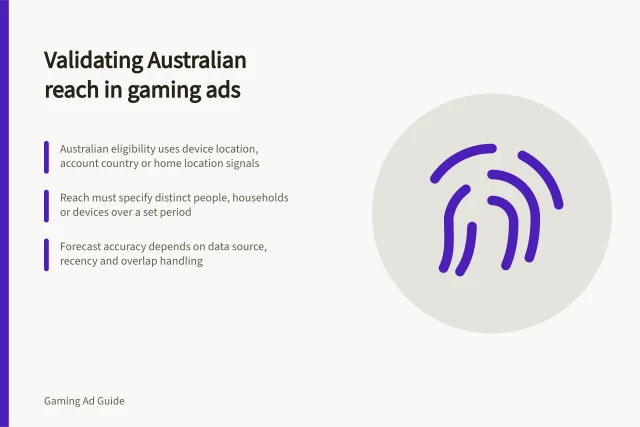
An Australia-targeted intrinsic campaign needs an explicit location rule and evidence the seller can apply it to the proposed games and devices. “Australian inventory” might mean a game popular in Australia, an Australian account or an ad request assigned to Australia. Those descriptions do not establish the same audience.
Define the intended market
State whether the campaign should reach devices likely to be in Australia at delivery, accounts associated with Australia or another defined group. Decide what happens when location is missing or when account country conflicts with a current signal. A game's language or setting is context, not proof of a player's location.
For each proposed supply path, ask which signal determines eligibility, the available regional detail and device coverage. Establish when the rule is applied and whether the report uses the same definition. A targeted country and a reported country can differ if the systems use different signals or times of assessment.
Examine the location signal
Location signals can include GPS, Wi-Fi, IP address, registration information and data passed in an ad or bid request. A request field may describe a current, home, work or last-known location; a city-level value does not by itself establish the device's current position.
Ask which signals are actually available for the proposed intrinsic inventory. Device types and supply paths may provide different information.
Where relevant, ask how VPNs, proxies, stale account details and missing location data are handled. Greater geographic detail should not be taken as greater accuracy without a validation method.
Buyer question / Answer to request
- How is eligibility checked in reporting?
- Reported location basis and any difference from the delivery rule
- When is location assessed?
- Decision point and age of any stored signal
- What if location is unknown?
- Exclusion or fallback rule and reporting treatment
- What can be reported?
- Available country, game and device breakdowns and unclassified traffic
Reconcile delivered geography
Agree before launch how to investigate delivery outside the approved geography. Request the most detailed country, game and device breakdowns the seller can reliably provide, plus an unclassified category.
Compare the reported delivery with the agreed eligibility rule and investigate material differences using the seller's methodology. A global reach estimate cannot substitute for Australian eligible or delivered counts.
Geographic targeting uses available signals; it does not guarantee a player's physical presence. If the seller cannot support the location condition needed for the offer, change the inventory or the campaign claim.